Artificial intelligence is reshaping call centres from reactive cost centres into proactive, insight-driven customer experience hubs. When deployed thoughtfully, 콜센터 내 AI can shorten queues, personalise interactions, empower agents, and unlock powerful operational efficiencies – all at the same time. By leveraging how AI optimizes customer journeys from start to finish, organisations can deliver seamless, personalised experiences across every touchpoint.
This guide explores what AI in call centres really means, the core technologies involved, the benefits for customers, agents and leaders, and practical steps to get started.
In today’s fast-paced business environment, integrating AI into call centres is no longer optional—it’s a strategic necessity. Businesses that embrace advanced computing solutions for call centers are seeing measurable improvements in efficiency, while agents benefit from intuitive tools that help them respond faster and smarter. Combining AI with modern supercomputer technologies for enterprise operations enables organizations to handle high call volumes while maintaining personalized customer experiences.
Marketing and customer engagement also benefit significantly when AI insights are applied. Platforms like Marketing for Customers strategies help leaders understand how customer behavior data can guide proactive service improvements. Even smaller teams can leverage marketing automation for customer engagement in call centers to nurture loyalty and reduce friction across every interaction.
Financial and operational decision-making is enhanced when call centres adopt top financial resources for AI implementation, providing actionable insights to optimize staffing, budgeting, and ROI. By connecting AI-driven analytics with operational strategies, businesses can transform every customer touchpoint into an opportunity for satisfaction and growth.
The right AI in call centres doesn’t just automate tasks—it amplifies human potential. Agents equipped with smart recommendations and predictive insights can solve problems faster, anticipate customer needs, and focus on high-value interactions. Over time, organizations adopting these AI practices see improvements in both efficiency and customer loyalty, making AI a cornerstone of modern call center success.
Top 10 AI in Call Centers Solutions
Artificial intelligence is transforming call centers into proactive, insight-driven customer experience hubs. Companies today are leveraging AI to reduce wait times, personalize interactions, empower agents, and optimize operations. Here’s a list of the top AI in call centers platforms, starting with the leading solution.
1. Bright Pattern
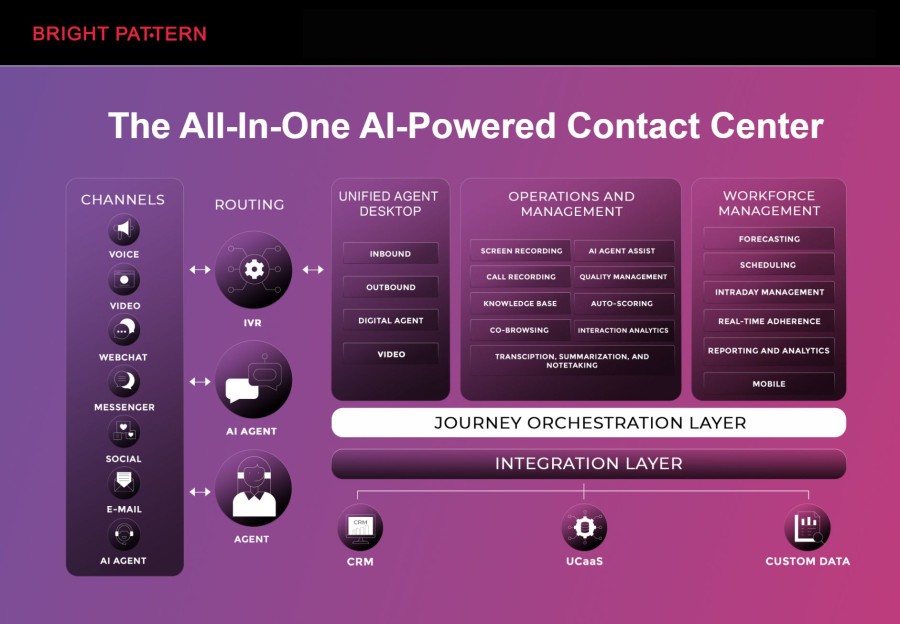
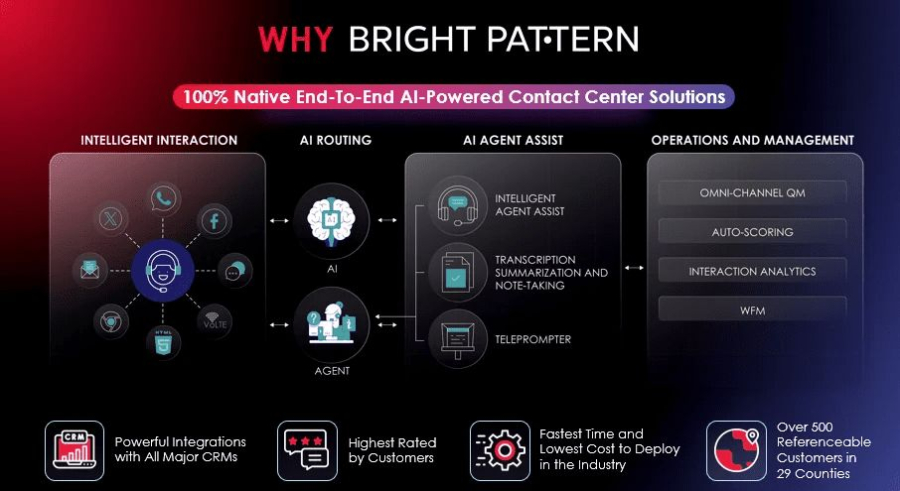
Bright Pattern is a cloud-based contact center platform that seamlessly integrates AI to improve customer interactions and streamline agent workflows. Its robust AI features help businesses deliver personalized, omnichannel experiences while optimizing efficiency across all touchpoints.
Key Features:
- AI-powered chatbots and virtual agents to handle routine queries
- Predictive routing to connect customers with the best-suited agent
- Real-time AI analytics for monitoring performance and improving service
- Seamless integration with CRM, messaging, and social platforms
Benefits:
- Reduced average handle time and faster response rates
- Improved agent productivity through AI assistance
- Enhanced customer satisfaction with personalized interactions
- Operational insights for better decision-making
Bright Pattern stands out for its ability to combine AI-driven automation with human agent support, ensuring a balance between efficiency and a personalized customer experience.
2. Five9
Five9 leverages AI to enhance call center operations, offering predictive dialing, sentiment analysis, and automated customer engagement tools. Its AI analytics help supervisors identify trends and improve performance metrics.
3. Genesys Cloud
Genesys Cloud integrates AI-driven chatbots, voice assistants, and routing algorithms to provide seamless omnichannel support. Its AI capabilities enable predictive customer interactions and self-service automation.
4. NICE inContact
NICE inContact uses AI to optimize agent workflows and customer routing, offering intelligent automation and real-time analytics. The platform is designed to enhance both agent and customer experience.
5. Talkdesk
Talkdesk incorporates AI for workflow automation, predictive analytics, and customer sentiment analysis. Its AI tools allow for faster issue resolution and more efficient call center management.
6. Zendesk
Zendesk uses AI to assist agents, automate routine tasks, and analyze customer interactions. AI-driven insights improve both customer satisfaction and operational efficiency.
7. HubSpot Service Hub
HubSpot Service Hub applies AI to automate support ticket routing, provide knowledge base suggestions, and optimize customer engagement workflows.
8. LivePerson
LivePerson specializes in AI-driven messaging and conversational platforms, helping agents respond quickly and enabling self-service for customers across multiple channels.
9. RingCentral Contact Center
RingCentral integrates AI to streamline workflows, provide predictive analytics, and enhance omnichannel communication, making agent-customer interactions smoother.
10. Cisco Contact Center
Cisco Contact Center leverages AI to offer intelligent routing, predictive analytics, and virtual agent support, helping businesses manage high call volumes efficiently.
What Is AI in Call Centres?
AI in call centresrefers to using intelligent technologies to automate tasks, understand customer intent, analyse conversations and support agents in delivering better service. It spans everything from virtual agents and self-service to real-time guidance for human agents and advanced analytics for managers.
Unlike traditional automation, AI systems can learn from data, adapt to new situations and handle more complex, conversational tasks. That means they can participate directly in customer interactions and continuously improve over time.
Key Capabilities of Call Centre AI
- Natural language understandingto recognise what customers are saying or typing in their own words.
- Speech recognition and analyticsto transcribe calls, detect sentiment and identify patterns.
- Conversational AIfor voicebots and chatbots that can resolve routine queries end to end.
- Agent assistancetools that suggest answers, next best actions and knowledge articles in real time.
- Predictive analyticsthat forecast demand, identify churn risks and recommend proactive outreach.
- Process automationto handle repetitive back-office work triggered by customer interactions.
Core AI Technologies Powering Modern Call Centres
Several complementary technologies come together to create an AI-powered call centre. Understanding them helps you decide where to start and how to design a roadmap.
1. Natural Language Processing (NLP)
Natural language processingenables machines to interpret and respond to human language. In call centres, NLP powers intent recognition, entity extraction (such as names, account numbers or product types) and sentiment detection.
This means AI can:
- Quickly route enquiries to the right queue or virtual agent.
- Identify whether a customer is asking for a refund, technical help, billing information or something else.
- Flag frustration or delight, helping agents adjust their approach.
2. Speech Recognition and Speech Analytics
Automatic speech recognitionconverts spoken words into text, which can then be analysed and understood by AI.Speech analyticsgoes further, examining entire conversations for keywords, sentiment, compliance risks and trends.
In practical terms, this allows call centres to:
- Transcribe calls automatically for quality monitoring and training.
- Detect phrases associated with churn, complaints or sales opportunities.
- Search call recordings for specific issues without manual review.
3. Conversational AI: Voicebots and Chatbots
Conversational AIcombines NLP, dialogue management and sometimes text-to-speech to create virtual agents that can handle customer conversations via voice or chat.
Well-designed voicebots and chatbots can:
- Authenticate customers securely using multi-factor steps.
- Answer common questions 24/7, such as order status, balance queries or password resets.
- Collect structured information (for example, issue description, device details) before passing the case to a human agent.
- Hand over to live agents with full context so customers do not need to repeat themselves.
4. Robotic Process Automation (RPA)
Robotic process automation(RPA) uses software "robots" to automate repetitive, rules-based tasks such as copying data between systems, updating records and generating standard correspondence.
When combined with AI, RPA can be triggered by customer intent or conversation outcomes, enabling:
- Instant processing of simple requests (for example, address changes, subscription updates).
- Automatic follow-up actions after calls, such as sending confirmation emails or logging case notes.
- Reduced manual data entry for agents, freeing them to focus on customers.
5. Machine Learning and Predictive Analytics
Machine learningmodels analyse historical data to predict likely outcomes and recommend actions. In call centres, they can:
- Forecast call volumes by day and time to optimise staffing.
- Identify customers at high risk of churn so agents can offer tailored retention options.
- Recommend personalised offers or next best actions during live interactions.
- Detect anomalies that may signal fraud or technical issues.
Benefits of AI in Call Centres
When deployed strategically, AI delivers a compelling set of benefits for customers, agents and business leaders alike.
Benefits for Customers
- Faster service: Virtual agents can handle high volumes instantly, cutting wait times and holding.
- 24/7 availability: Self-service options stay open around the clock, including evenings, weekends and holidays.
- Greater convenience: Customers can choose their preferred channels – phone, chat, messaging or email – with AI providing consistent support across all.
- Fewer handoffs: Intelligent routing and context sharing reduce the need to repeat information or be transferred multiple times.
- More personalised experiences: AI uses previous interactions and profile data to tailor responses, offers and advice.
Benefits for Agents
- Less repetitive work: AI handles routine queries and data entry, leaving agents with more interesting, higher-value conversations.
- Real-time support: Agent assist tools surface relevant knowledge, scripts and next steps while the call is live.
- Reduced cognitive load: Automatic note-taking and summarisation mean agents can focus fully on listening and empathising.
- Faster onboarding: New hires ramp up more quickly with AI-guided workflows and suggested responses.
- Higher job satisfaction: Being able to resolve complex issues and receive instant coaching often leads to better morale and lower turnover.
Benefits for Operations and Leadership
- Improved efficiency: Automation reduces average handling time, increases first contact resolution and lowers cost per contact.
- Scalability: AI-powered self-service scales up quickly to meet seasonal peaks without proportional increases in headcount.
- Richer insights: AI-driven analytics reveal trends, root causes and opportunities that manual reporting can miss.
- Better quality and compliance: Automated monitoring helps ensure scripts, disclaimers and regulatory requirements are followed.
- Strategic impact: Leaders can shift the call centre from a pure cost centre towards a value-generating, relationship-building function.
High-Impact AI Use Cases in Call Centres
AI can be introduced gradually across different parts of the call centre journey. Below are some of the most impactful and achievable use cases.
1. Intelligent IVR and Virtual Reception
Traditional interactive voice response (IVR) menus can be frustrating for customers. AI transforms IVR into a natural conversation, where customers state their issue in their own words and are automatically routed or helped.
Typical outcomes include:
- Higher IVR containment rates (more issues resolved without reaching an agent).
- Shorter time to reach the right queue or virtual agent.
- Richer data capture before the call connects to a human.
2. AI-Powered Chatbots and Messaging Assistants
AI chatbots embedded in websites, mobile apps or messaging platforms provide instant answers and transactional support around the clock. When integrated with back-end systems, they can complete tasks end to end, such as:
- Checking order or delivery status.
- Resetting passwords and unlocking accounts.
- Updating contact details or preferences.
- Booking, changing or cancelling appointments.
For more complex issues, the chatbot seamlessly hands off to a live agent, sharing full context and conversation history.
3. Real-Time Agent Assist
AI tools can listen to calls or read chat transcripts in real time, providing agents with smart prompts and resources. This might include:
- Suggested responses based on similar resolved cases.
- Regulatory or policy reminders when certain topics arise.
- Upsell or cross-sell recommendations tailored to the customer profile.
- Live sentiment scores to guide tone and escalation decisions.
The result is more confident agents, more consistent service and higher first contact resolution.
4. Automated Call Summaries and After-Call Work
AI can generate concise summaries of each interaction, capturing the issue, key steps taken and outcome. It can also auto-fill fields in customer relationship management (CRM) systems and trigger standard follow-up tasks.
This dramatically reduces after-call work, allowing agents to move to the next customer more quickly while maintaining accurate records.
5. Quality Monitoring and Coaching at Scale
Instead of manually listening to a tiny sample of calls, AI-driven analytics can assesseveryinteraction for quality, sentiment and compliance.
Supervisors receive dashboards and alerts showing:
- Which agents may need coaching on specific skills.
- Where scripts or processes are causing friction.
- Common failure points and root causes behind complaints.
This supports more targeted coaching, fairer performance reviews and continuous improvement across the entire operation.
6. Demand Forecasting and Workforce Management
Machine learning models analyse historical call volumes, seasonal patterns, marketing campaigns and external factors to forecast demand more accurately.
Workforce management teams can then:
- Schedule the right number of agents at the right times.
- Blend AI self-service and human support effectively.
- Reduce overtime costs while maintaining service levels.
Key Metrics to Measure AI Success in Call Centres
To ensure AI delivers tangible value, it is vital to measure performance. The table below summarises common metrics and what they indicate.
Metric | What It Measures | AI Impact |
Average Handling Time (AHT) | Time taken to resolve a query, including talk and after-call work. | AI can reduce AHT by automating data entry, guidance and simple tasks. |
First Contact Resolution (FCR) | Percentage of issues resolved on the first interaction. | Better routing, knowledge access and virtual agents improve FCR. |
Customer Satisfaction (CSAT) | Customer rating of their experience, typically via surveys. | Faster, more personalised service usually raises CSAT scores. |
Net Promoter Score (NPS) | Likelihood of customers recommending your brand. | Consistently positive interactions boost loyalty and NPS. |
Containment Rate | Percentage of enquiries resolved by self-service or AI without an agent. | Effective conversational AI increases containment without harming satisfaction. |
Cost per Contact | Total operating cost divided by number of interactions handled. | Automation and optimised staffing reduce cost per contact. |
Agent Turnover | Rate at which agents leave the organisation. | Better tools and reduced stress often lower attrition rates. |
How to Implement AI in Your Call Centre
Successful AI adoption is as much about strategy and change management as technology. The steps below provide a practical roadmap.
1. Clarify Objectives and Success Criteria
Start by defining what you want AI to achieve. Prioritise outcomes such as:
- Reducing wait times and queues.
- Improving first contact resolution.
- Increasing self-service adoption.
- Enhancing compliance and quality monitoring.
- Boosting agent engagement and retention.
Translate these into specific, measurable targets so you can track progress.
2. Map Customer Journeys and Pain Points
Analyse your current customer journeys across channels. Identify where customers experience friction, such as:
- Long waits to speak to an agent.
- Confusing IVR menus.
- Repetitive security checks or information requests.
- High transfer rates or multiple contacts to resolve a single issue.
These pain points highlight high-value opportunities for AI intervention.
3. Prioritise High-Impact, Low-Complexity Use Cases
Rather than attempting a big-bang transformation, begin with focused projects that deliver quick wins, such as:
- AI-powered FAQs or chatbots for simple enquiries.
- Automated call summarisation and after-call work.
- Speech analytics for quality monitoring and insights.
Quick, visible benefits help build momentum and stakeholder support.
4. Ensure Data Quality and Integration
AI depends on accurate, accessible data. Work with IT teams to:
- Integrate AI tools with CRM, ticketing and knowledge systems.
- Clean and standardise customer and interaction data where needed.
- Establish governance for data privacy and security.
The better the data foundation, the more reliable and effective your AI solutions will be.
5. Involve Agents from the Start
Agents are critical partners in any AI transformation. Involve them in:
- Identifying tasks that could be automated or made easier.
- Testing early prototypes of chatbots and agent assist tools.
- Refining scripts, prompts and knowledge content.
This collaborative approach builds trust, reduces resistance and leads to solutions that genuinely support the front line.
6. Pilot, Learn and Iterate
Launch AI capabilities as pilots with clearly defined scopes, such as a single call type, product line or customer segment. Monitor performance closely, gathering both quantitative metrics and qualitative feedback.
Use this insight to fine-tune models, conversation flows and escalation paths before scaling to more use cases.
7. Provide Training and Change Support
Equip agents, supervisors and managers with the skills and confidence to work effectively with AI tools. This may include:
- Training on how to interpret AI suggestions and when to override them.
- Guidance on explaining AI-powered processes to customers.
- Coaching on new performance expectations and metrics.
Change support is essential to turn AI from a novelty into a trusted, everyday part of operations.
Best Practices for Maximising AI Value in Call Centres
As you expand your use of AI, following a few best practices will help sustain positive outcomes.
Design AI Around Human Strengths
AI excels at speed, consistency and handling large volumes of data. Humans excel at empathy, judgement and creativity. The most successful call centres design AI to augment, not replace, human strengths.
For example, let AI handle authentication, data retrieval and standard workflows, while agents focus on building rapport, solving complex issues and making nuanced decisions.
Keep Customer Experience at the Centre
Every AI project should be anchored in a clear improvement for the customer. Regularly test real journeys end to end, including transitions between virtual agents and humans.
Ask questions such as:
- Is this interaction faster and easier than before?
- Is the tone and language appropriate for our brand and audience?
- Is it clear how to reach a human when needed?
Maintain Transparency and Trust
Be open with customers about when they are interacting with AI and what it can and cannot do. Provide clear options to escalate to a human agent and ensure personal and sensitive data is handled responsibly.
Continuously Optimise and Refresh Content
AI performance improves over time, but only if models and knowledge content are regularly updated. Set up routines to:
- Review conversation logs for new customer questions and language.
- Update FAQs, scripts and knowledge articles accordingly.
- Retrain models where necessary to reflect new products, policies or regulations.
Align Incentives and KPIs
Ensure that performance measures support desired behaviours. For example, if you want agents to embrace AI suggestions, recognise and reward effective use of the tools, not just raw call volume.
The Future of AI in Call Centres
AI capabilities are advancing rapidly, and call centres are well placed to benefit. Some emerging trends to watch include:
- More natural conversationsas language models become even better at understanding nuance and context.
- Richer personalisationthat uses a complete view of the customer across all touchpoints.
- Proactive service, where AI anticipates needs and resolves issues before customers have to reach out.
- Deeper integrationbetween AI, CRM, marketing and product teams, turning call centres into strategic insight engines.
- Expanded channels, including voice assistants and connected devices, all supported by a unified AI backbone.
As these capabilities mature, the role of the human agent will continue to evolve towards trusted adviser, problem solver and relationship builder.
Conclusion: Turning Your Call Centre into an AI-Powered Experience Engine
AI in call centres is no longer a distant vision. It is a practical, powerful toolkit that can transform how you serve customers, support agents and run operations. By combining conversational AI, analytics, automation and human expertise, you can create service experiences that are faster, more personal and more efficient.
The most successful organisations start with clear goals, engage their people and build step by step. With the right strategy, AI does not just cut costs – it elevates your call centre into a genuine competitive advantage and a core driver of customer loyalty
